WASHINGTON — The U.S. House of Representatives voted Tuesday night to advance a war powers resolution aimed at ending U.S. military action against Iran without congressional authorization.
The measure passed 220–204, with all House Democrats joined by seven Republicans.
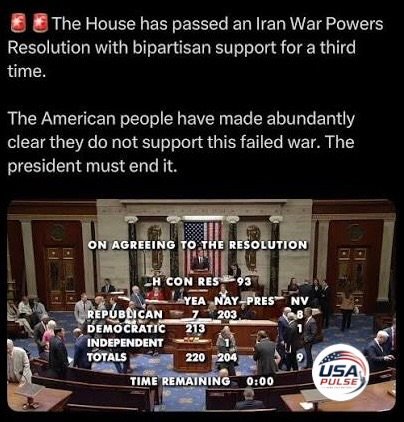
It marks the third time the House has approved a resolution seeking to limit President Donald Trump’s ability to continue military operations against Iran without congressional approval.
Seven Republicans Join Democrats
The latest vote showed increased Republican support compared with previous attempts to restrict the war.
The seven Republicans who supported the resolution were:
Zachary Nunn of Iowa, Mariannette Miller-Meeks of Iowa, Nancy Mace of South Carolina, Tom Barrett of Michigan, Warren Davidson of Ohio, Brian Fitzpatrick of Pennsylvania and Thomas Massie of Kentucky.
Previous House votes attracted support from four Republicans.
Does the Vote End the Iran War?
No.
Although the House approved the resolution, the vote does not immediately stop U.S. military operations against Iran.
Previous congressional efforts to restrict the conflict have failed to reach President Trump’s desk.
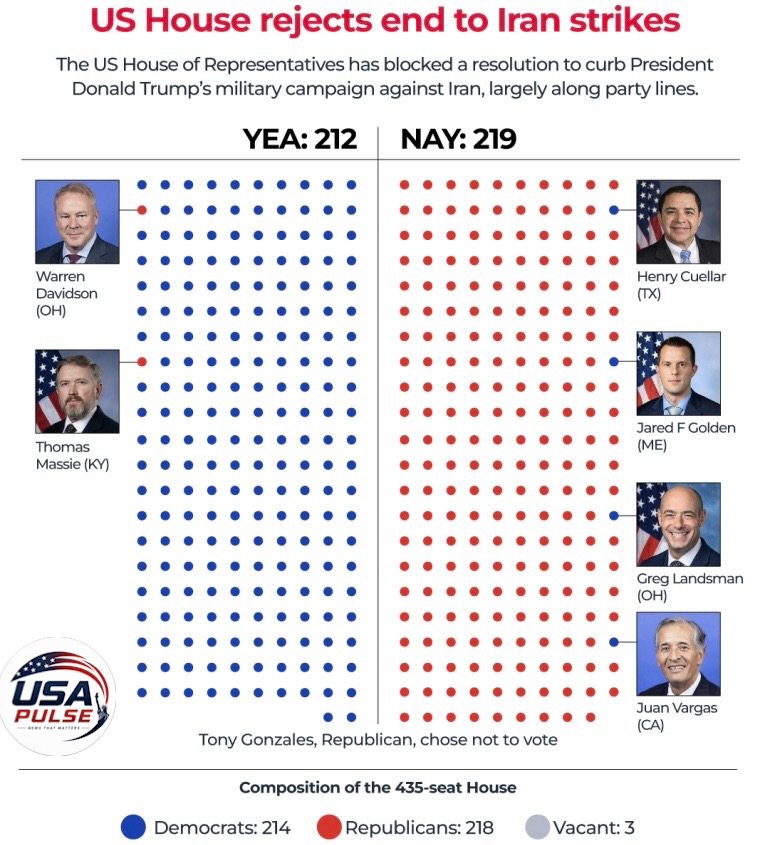
Even if such a measure ultimately reaches the president, Trump is expected to oppose it.
Congress would face additional hurdles before any restriction could become binding.
Debate Over Presidential War Powers
The vote centers on a long-running constitutional debate over who has the authority to sustain U.S. military operations.
The Constitution gives Congress the power to declare war, while the president serves as commander in chief.
The War Powers Resolution was designed to limit how long presidents can continue certain military operations without congressional authorization.
Supporters of Tuesday’s resolution argue Congress should have a greater role in deciding whether the Iran conflict continues.

Opponents argue Iran continues to pose a threat to U.S. interests and that restricting the president could undermine ongoing military operations.
Iran War Becomes Major Midterm Issue
The vote comes less than two months before the November 3 midterm elections.
The U.S.–Iran conflict has continued for nearly seven months following U.S. and Israeli strikes against Iran on February 28.
Beyond the fighting itself, the economic consequences are increasingly affecting the political debate in Washington.
Disruption to oil shipments through the Strait of Hormuz has contributed to higher energy prices.
A new Congressional Budget Office assessment estimates the war had cost the United States more than $38 billion through August 1, with additional costs potentially running between $2 billion and $3 billion per month, depending on the intensity of military operations.
What Happens Next?
The House vote increases political pressure on Washington over how long U.S. military operations against Iran should continue.
But it does not, by itself, bring the conflict to an end.
With lawmakers preparing to leave Washington to campaign ahead of the midterm elections, the Iran war — and its military and economic costs — is likely to remain a major issue in U.S. politics.