WASHINGTON — Several senior U.S. military leaders have warned Defense Secretary Pete Hegseth that prolonging large-scale military operations against Iran could become unsustainable and weaken America’s ability to respond to threats elsewhere in the world.
The concerns were included in a recent classified Pentagon assessment, according to people familiar with the document who spoke to The Washington Post.
More Than 50,000 U.S. Troops on Alert
U.S. Central Command has kept more than 50,000 troops on alert in the Middle East for months as President Donald Trump continues pressuring Tehran over the Strait of Hormuz and terms for ending the conflict.
Some American forces are currently scheduled to remain in the region through September, while certain deployments could continue into 2027, according to the report.
Military Commanders Raise Concerns
The classified assessment reportedly includes concerns from senior officials responsible for U.S. operations in Europe, the Pacific and Latin America.
Ships, aircraft and other military equipment have been redirected from those regions to support operations connected to Iran.
Some commanders warned that this is reducing their ability to conduct missions, maintain training and prepare for other potential threats.
U.S. Navy Under Heavy Pressure
The Navy appears to be facing particularly serious strain.
According to The Washington Post, Chief of Naval Operations Adm. Daryl Caudle warned that the Navy cannot indefinitely maintain its current level of support for the Iran conflict without an anticipated end date.
The report says only about one-quarter of the Navy’s destroyer fleet is currently ready to deploy, according to people familiar with the classified assessment.
Extended deployments are also putting additional pressure on sailors, ship maintenance and the Navy’s ability to prepare vessels for future operations.
Concerns Over U.S. Weapons Stockpiles
The Iran conflict has also placed pressure on important American weapons inventories.
Patriot and THAAD air-defense interceptors and Tomahawk missiles have been heavily utilized, while approximately 25% of the Pentagon’s Reaper drone fleet has been lost, according to The Washington Post.
The Trump administration has disputed reports suggesting that U.S. ammunition inventories have reached critically low levels.
Could Other Regions Become More Vulnerable?
The concern extends beyond the Middle East.
U.S. commanders must maintain forces capable of deterring Russia in Europe, China in the Indo-Pacific and threats closer to the American homeland.
Moving additional ships, aircraft and missile-defense systems toward the Middle East could therefore create difficult choices for Pentagon planners if another major crisis develops.
Trump Keeps Military Option Open
Trump continues to pressure Iran to reopen the Strait of Hormuz and accept U.S. conditions for ending the conflict.
The president has also maintained that further military action remains an option.
For Pentagon planners, however, the latest assessment highlights an increasingly difficult question: how long can the United States maintain its current military commitment to the Iran conflict without weakening readiness elsewhere?
The Pentagon told The Washington Post that force deployments are determined by current threats, presidential strategic priorities and advice from senior military commanders. It declined to discuss details of classified internal assessments.
USA Pulse will continue following developments involving the U.S., Iran and American military operations in the Middle East.
Source: The Washington Post — Military leaders warn Hegseth against extending Iran war operations
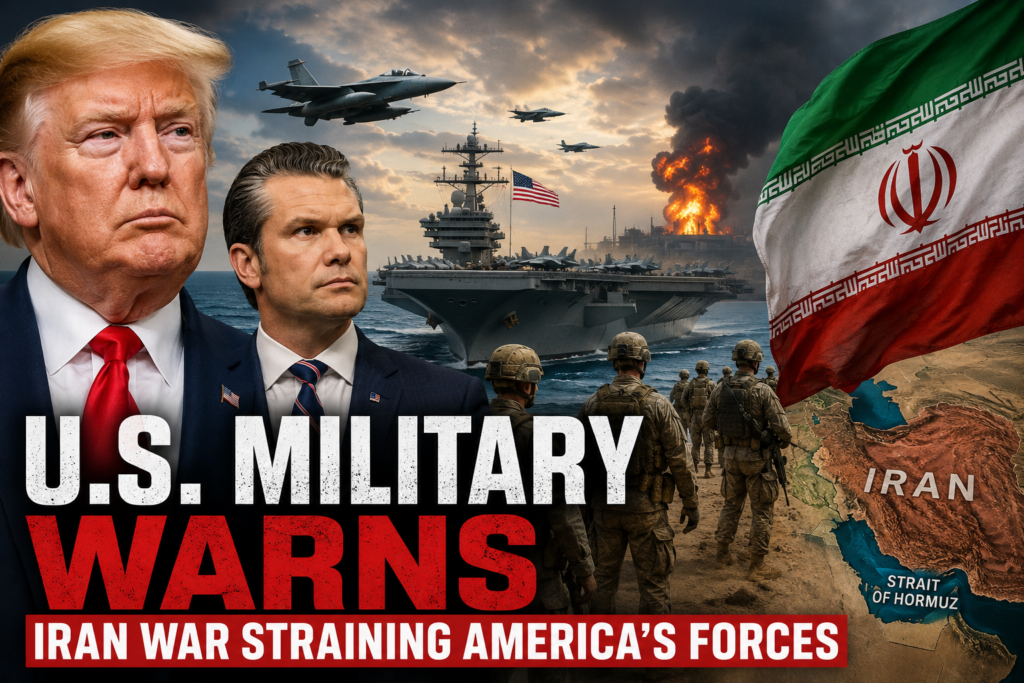
Za featured image bi odel so: Trump + Hegseth + U.S. aircraft carrier + American troops + Iran flag, i golemo:
U.S. MILITARY WARNS
IRAN WAR STRAINING AMERICA’S FORCES 🇺🇸🇮🇷